Tax Strategy
S-Corp Owner's Salary: How to Set Reasonable Compensation the IRS Won't Question
Also on LinkedIn
If you own an S corporation and work in the business, deciding how much to pay yourself is an important year-end tax planning task. Your salary affects payroll taxes, retirement contributions, estimated taxes, and potentially the Qualified Business Income (QBI) deduction.
There is no single salary formula that applies to every S corporation. The goal is to set compensation that reflects the work you actually perform, document how you arrived at the amount, and run it through payroll. Reviewing your pay before December 31 gives you time to address a shortfall while the tax year is still open.
Why S-Corp owners need to pay themselves through payroll
An S corporation shareholder who performs services for the business and receives, or is entitled to receive, compensation is generally treated as an employee for federal employment tax purposes. The IRS says shareholder status does not change that rule.
An owner who works in the business must receive reasonable compensation through payroll before taking non-wage distributions for those services. The IRS may reclassify distributions or other payments as wages when they are compensation for the owner’s work. Reclassified amounts may be subject to payroll taxes, interest, and penalties.
A distribution is not a substitute for wages just because it is labeled an owner draw. This is especially important for a business where the owner personally performs most of the revenue-generating work.
Review the IRS guidance on S corporation compensation and S corporation employees, shareholders, and corporate officers.
How to determine reasonable compensation
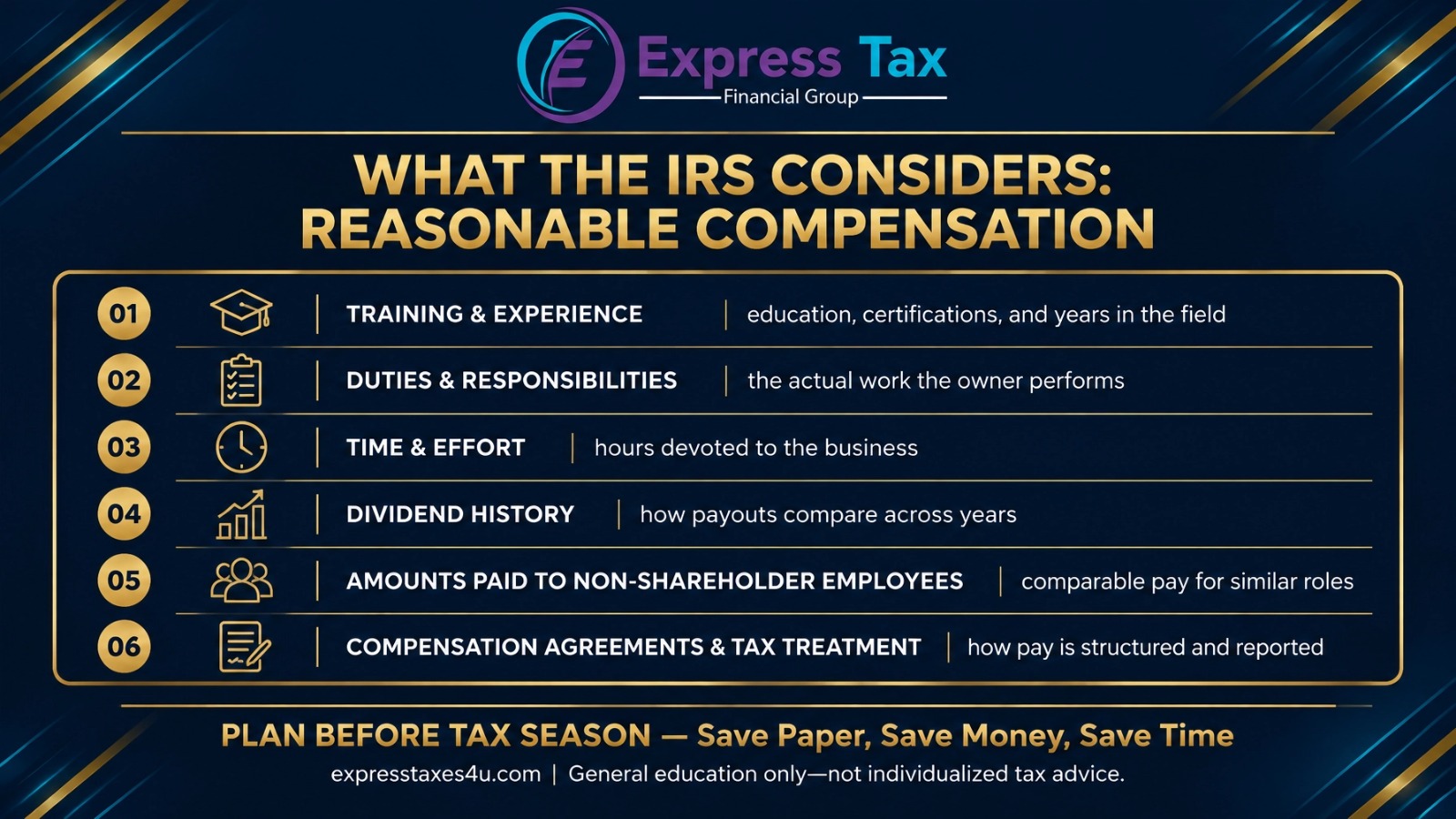
The IRS does not use one fixed formula or salary percentage. It considers the facts and circumstances of the business and the shareholder-employee’s services. Factors may include:
The owner’s duties, responsibilities, training, and experience
Time and effort devoted to the business
Industry norms and pay for comparable work
Compensation paid to non-owner employees
The company’s compensation agreements and history
The source of the company’s revenue
That last factor can be helpful. Consider how much revenue is generated by your personal services, compared with revenue produced by employees, equipment, or invested capital. If you provide the service that generates most of the income, your compensation should reflect the value of that work. Owners who manage staff or oversee business assets also perform services, even if they are not directly serving customers.
Think about what the company would reasonably pay someone else to perform your duties. If you have several roles (such as sales, professional services, operations, and management) consider each role and the time required.
How to document your compensation decision
A reasonable figure is easier to support when your records show how you reached it. Keep a file with:
A current job description. List your responsibilities, including both revenue-generating and management work.
A record of your time and effort. A time log or regular estimate of hours can help show how much work you perform.
Market compensation information. Compare similar roles, taking account of location, industry, experience, business size, and hours. Use credible salary surveys, government labor data, or other reliable sources.
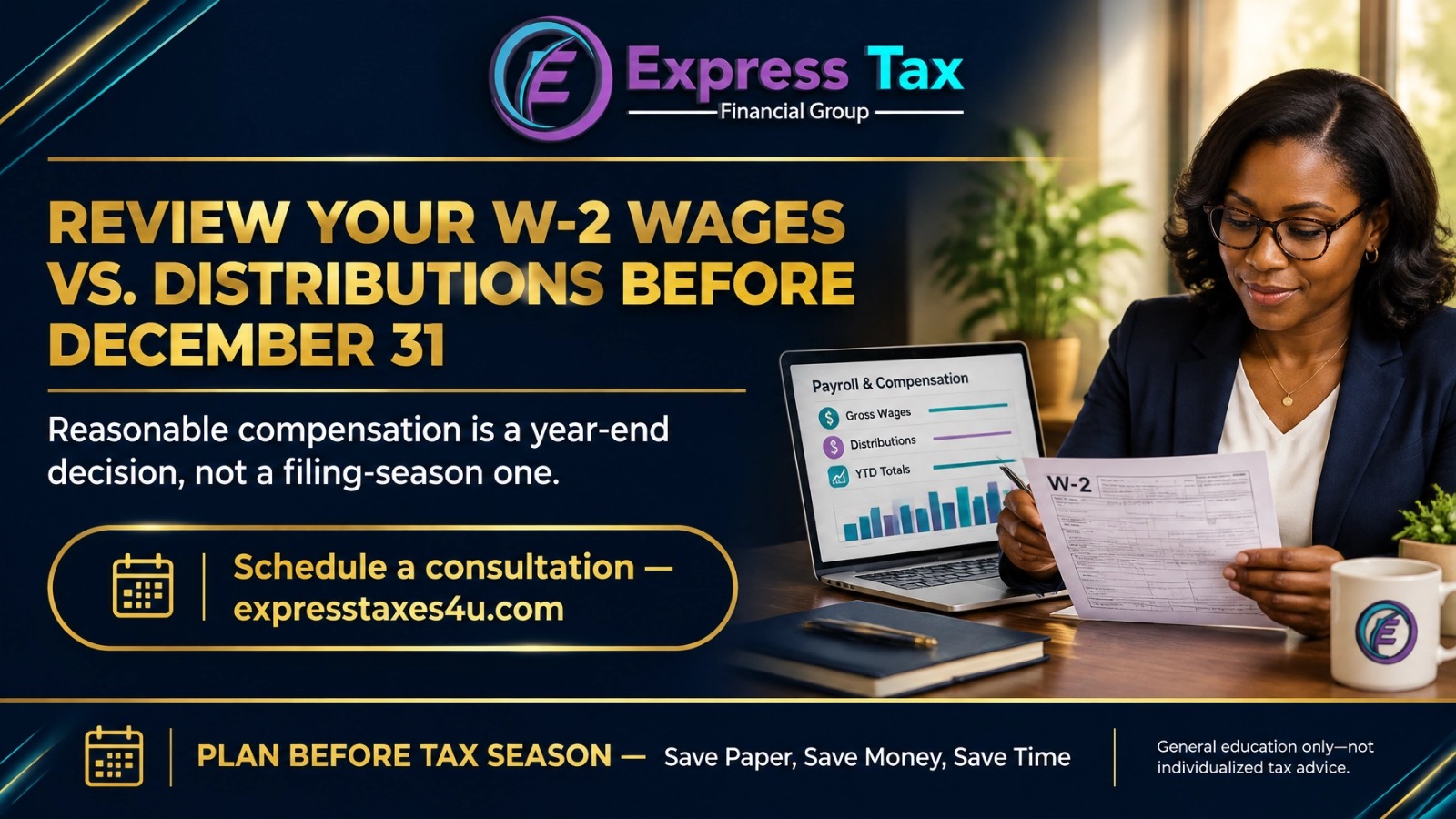
Payroll records. Keep payroll registers, Forms W-2 and 941, and records of tax deposits.
A written compensation decision. Record the amount, the factors you considered, and any changes to your duties or hours.
Revisit the analysis when your role, hours, business activity, or staffing changes. This is not about finding a number that guarantees the IRS will agree. It is about making and documenting a defensible decision based on the work performed.
Year-end payroll: review wages and distributions before December 31
Before year-end, compare the compensation you have paid through payroll with the work you performed and the distributions you took. If your salary needs a true-up, talk with your payroll provider and tax professional about whether additional payroll or a year-end bonus is appropriate.
For compensation to be reported as wages for the current year, it generally needs to be paid through payroll by December 31. A bookkeeping entry alone may not make an unpaid bonus current-year wages. A bonus should reflect services performed, be processed as payroll, and fit the company’s compensation records and cash flow.
Also confirm that payroll tax deposits and filings are current. The required deposit schedule depends on your circumstances, so verify the deadlines that apply to your business rather than assuming the year-end payroll date is the only date that matters.
A year-end review can help prevent several common mistakes:
Paying no salary, or only a token salary, while taking substantial distributions
Treating all owner draws as distributions, without accounting for compensation
Waiting until tax season to consider whether payroll was adequate
Setting a salary based only on a desired tax result, without evidence tied to the owner’s work
How salary interacts with QBI, retirement contributions, and estimated taxes
QBI deduction: S corporation wages paid to an owner are not QBI. Salary and other deductible compensation can also reduce the business income that may qualify for the deduction. At the same time, W-2 wages can matter when applying certain QBI limits. The rules depend on your taxable income, business type, and other facts, so compare the overall tax impact rather than focusing on one deduction. See the IRS overview of the Qualified Business Income deduction.
Retirement contributions: Retirement-plan contributions for an S corporation shareholder-employee are generally based on W-2 compensation, not shareholder distributions. The IRS explains that distributions do not count as earned income for these purposes. Review the IRS retirement plan contribution FAQs for S corporations and coordinate payroll with your plan administrator.
Estimated taxes: S corporation income generally passes through to the shareholder, while wages are subject to payroll withholding. Distributions and pass-through income do not automatically have withholding, so you may need estimated tax payments. A year-to-date projection can help you decide whether to adjust withholding, estimated payments, or both.
These connections are one reason to avoid setting salary in isolation. A change that affects payroll taxes may also affect retirement funding, withholding, cash flow, and your estimated tax position.
Plan before year-end, not during filing season
Changing pay or business structure solely to pursue a tax result can create payroll, compliance, and cash-flow problems. If you are an LLC owner considering an S corporation election, weigh the administrative costs, payroll requirements, and likely overall tax impact before making a change.
Tax preparation reports what has already happened. Proactive tax planning looks forward and gives you a chance to review your position while decisions can still be made. A year-end payroll review can help you understand the tradeoffs and prepare for upcoming obligations.
Express Tax Financial Group provides business tax services and advisory support for business owners who want to make informed decisions throughout the year. To discuss your situation, visit expresstaxes4u.com or schedule a consultation. Existing clients can access the client portal.
Save Paper, Save Money, Save Time by keeping payroll, compensation records, and tax documents organized and accessible.
This article is for general educational purposes only. It is not individualized tax, legal, accounting, or financial advice. Tax rules can change, and their application depends on your circumstances. Consult a qualified tax or other professional before making decisions about compensation, payroll, or business structure.